Tuesday, 2 October 2018

Lesson 3 - Media Language V Genre

Learning Objectives:

Know: the areas of study referring to media language and genre as directed by the OCR spec.
Understand: how media language affects genre.
Be Able To: demonstrate your understanding of how these areas are applied via a practical activity.
Communication Objective: Use media terminology (both old and new) in your verbal and written communication).


-----------------------

Part 1

Create a new post in your blogger and title it: Media Language V Genre.

Copy and Paste the learning Objectives from above into your own blog post.

Copy and paste the questions below:


  • Why do you think it's important for the media industry to follow typical conventions of any given genre?

  • Why do you think some media products challenge genre conventions?
  • Why do you think media producers use intertextuality in their media texts?

You will be answering these later on in the lesson.


Part 2

Go online and search for "nearpod.com".

Input the class code the teacher gives you


After going through this lesson, please go back to the questions you pasted at the start of the lesson and answer them...

  • Why do you think it's important for the media industry to follow typical conventions of any given genre?
  • Why do you think some media products challenge genre conventions?
  • Why do you think media producers use intertextuality in their media texts?


---------------------------


Part 3- Visual dictionary.

For this visual dictionary you need to evidence that you understand genre as a concept and the importance of following conventions... 

Find examples (images) of 4 different media texts that belong to 4 different types of genres (chosen by you).  For example:

4 examples of texts that belong to the Horror genre.
4 examples of texts that belong to the Sci-Fi genre.
4 examples of texts that belong to the Action genre.
4 examples of texts that belong to the Romantic genre.
4 examples of texts that belong to the Period Drama genre.

MAKE SURE YOU DON'T JUST USE MOVIES... YOU CAN ALSO USE MUSIC VIDEOS, TV PROGRAMMES AND MAGAZINES.

Examples of music videos:

Examples of TV series:
Dr Who - Sci-Fi.
Downton Abbey - Period Drama.


What technology will you use to make this? A sway? Prezi? A padlet?

The following information must be included in the visual dictionary:


What is genre?
What do we mean by "codes and conventions"?
In your opinion, why does the media follow conventions?
Why would a media product challenge conventions? Can you think of an example?
What do we mean when a media product is of a Hybrid Genre?
What do we mean by intertextuality?


THEN... with each of your examples you must answer the following questions:
  • Name of text
  • What genre is this text?
  • What codes and conventions can you identify in your text? - These need to be linked to media language in terms of camera shots, mise-en-scene (performance, lighting, props, settings, costume, hair and make up), sound and editing.
  • Is it a hybrid genre? If so, what other?


Here's an example we made earlier:


-----------------------------


Success Criteria:

  • You need to make sure you use full sentences in your explanations... not just one-two word answers.
  • You need to make sure you use media language throughout.


Tuesday, 18 September 2018

Lesson 2 - Representation

Learning Objectives:

K: The concept of representation and stereotype in the media.

U: How and why media texts encourage or challenge representations and stereotypes.
BAT: Discuss the influence of representation, both negative and positive.
CO: Use media terminology throughout your verbal and written communication.

--------------------------


KEY POINT 1 - COPY AND PASTE THIS IN YOUR BLOG POST.

For many of us, the media are the key source of our understanding of the world.
For example, what is it like to live in Australia?  If you have not been there, how do you know this?
Many people believe that the media are a powerful means of shaping our attitudes and beliefs – what does this mean??

REPRESENTATION is the process the media presents the "real" world to us.

--------------------------


TASK 1 - CREATING REALITIES.


WHAT MAKES THESE CLIPS REAL? - Class discussion.


Sainsbury's Christmas advert: 

https://harrisfederation-my.sharepoint.com/:v:/g/personal/l_amador_hfed_net/EXWSSmxT78VHkNPen2tgJioBg_8FBW5Irh-oV5Q8OJJCvg?e=7tWWll


-----------------------------

Friends Clip: 
https://harrisfederation-my.sharepoint.com/:v:/g/personal/l_amador_hfed_net/EUg4sJpCSfhBt5t9W3AN0tEB1Vzzy9bsA9yZUUdNwX_SPQ?e=gi1KRQ


----------------------------

X Factor: https://harrisfederation-my.sharepoint.com/:v:/g/personal/l_amador_hfed_net/EeEmqeCZFudBskA9IpNaif0Bd2bJM0YXleeIprjD_VyBuw?e=infcA8


In your blog post - answer the following question...


Can we trust the media?

If the media "constructs/presents" "reality" to us... What do they have to take into account?

--------------------------

TASK 2 - STEREOTYPES

A Stereotype is the portrayal of people or places through a few obvious/universally accepted characteristics.


Look at these images...


Pick two of these, Copy and Paste them to your blog post and answer the following questions about them:

  • Who are they representing?


  • Is it a positive or negative representation?
  • What media language are they using to create these representations?

  • Why do you think these representations were created?
  • Think of potential brands/companies/charities that might use your chosen images for advertising...what kind of caption/message would you suggest?


--------------------------

KEY INFO 2 - STEREOTYPES IN THE MEDIA

Some people argue that the media follows stereotypes to make audiences feel safe as they know what to expect.

Some other people argue that the media controls the way you think.
Some other people argue that some representations are unfair and not true.

These people are called THEORISTS.


Here are the most popular theories in the media today:


There are 9 theories in this quizlet... the idea is that you play a few 'revision games' to get familiar with them... this is a great revision tool (and fun too!).


--------------------------

TASK 3 - APPLYING MEDIA THEORIES TO REPRESENTATION.


Watch the advert for Diet Coke.

Link: https://harrisfederation-my.sharepoint.com/:v:/g/personal/l_amador_hfed_net/EW9mGky7DGNJh22huw6OCSABXNm2acrHRYINtxS8He5OUQ?e=P8IiG8


  • What stereotypes are they using in this advert? Do you think they are positive or negative representations?
  • Why do you think it is important for media companies to follow/encourage stereotypes?
  • What media theories can you apply to this advert?


---------------------------


AT THE END OF THE LESSON


Write 3 statements that sum up what we learnt today about representation and their theories.


--------------------------

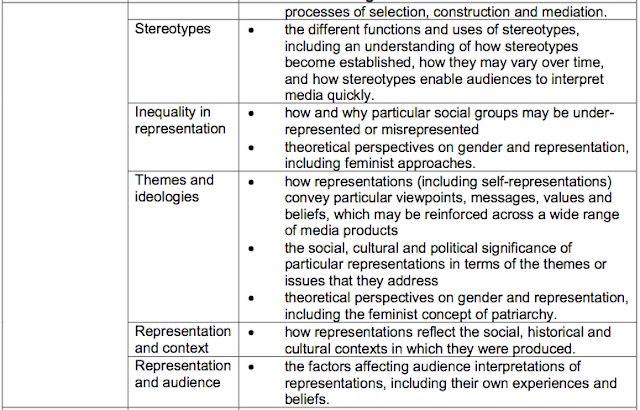
These are the areas of Media Representation we will cover in the course: